Guest Post by Carol Browne
As authors go, I consider myself to be fairly ignorant when it comes to the mechanics of my craft. I’m like someone who drives but hasn’t a clue how the engine works and can’t tell one make of car from another. I find myself perplexed at times by the multitude of genres and their crossovers. Similarly, the many structures and formats one is supposed to adhere to are tiresome. Perhaps I don’t like rules and regulations, or it could be I’m too lazy to learn them.
Recently, when I finished my latest work, a novella called Reality Check, I decided to address my ignorance of basic literary structures by finding out exactly what constitutes a novella.
The novella (Italian,‘new’) started to develop as a literary genre during the Renaissance (notably in 1348 with the The Decameron by Giovanni Boccaccio), and in the late-eighteenth and early-nineteenth centuries the genre acquired various rules and structural requirements.
With a word count of between 17,500 and 40,000, the novella tends to be more complex than a short story but has far fewer conflicts than a novel. Frequently a novella is designed to be read at a single sitting.
Chapter divisions, subplots, different points of view, and changes in genre are not features commonly found in the novella. It turns its back on the wider world to focus instead on personal development. It’s like taking a short story then embellishing it with descriptive passages, expanding on the characterisation, and exploring the conflicts in greater depth.
You’d be surprised to know how many great literary works are novellas—Franz Kafka’s The Metamorphosis, John Steinbeck’s Of Mice and Men, F. Scott Fitzgerald’s The Great Gatsby, and Oscar Wilde’s The Picture of Dorian Grey, to name but a few.
I’m surprised to find that Reality Check meets the requirements, albeit by accident! Out of interest I also note that German writers see the novella as a narrative of any length that focuses on one suspenseful situation or conflict, with a decisive turning point that leads to a reasonable but surprising conclusion. Reality Check has ticked all the boxes there too. All I need now is a publisher!
Carol Browne regards Crewe, Cheshire, as her home town and graduated from Nottingham University in 1976 with an honors degree in English Language and Literature. Carol writes speculative fiction, non-fiction, and poetry. She is also a ghost blog writer, proofreader, copy editor, and copywriter. Along with a passion for gardening, Carol is an avid animal lover.
Carol lives in the Cambridgeshire countryside with her dog, Harry, and cockatiel, Sparky.Pagan and vegan, Carol believes it is time for a paradigm shift in our attitude to Mother Nature and hopes the days of speciesism are numbered.
Stay connected with Carol on her website and blog, Facebook, and Twitter.
Showing posts with label writing. Show all posts
Thursday, August 18, 2016
Monday, July 20, 2015
Balancing Life and Writing #writerslife #familylife
This is topic that every writer struggles with, at times more than others. Writing has been my career for over 13 years, and I’ve found this question evolves as my life has evolved.
Writing as an escape: When my children were toddlers, as much as I loved my kids, I was losing myself and completely bogged down in the small, emotionally exhausting day-to-day details of caring for small children. I returned to writing, and it became my escape and my “me-time.” Because I was happier and more fulfilled, I became a better parent and spouse.
Writing to prove myself: Once my youngest child was in school, writing was no longer an escape. It was my job, and I desperately wanted to be published and turn the career I’d chosen into a success. I guarded my writing time fiercely because I had a very limited amount. When the kids came home, my work time was over.
Writing is part of who I am, but it’s not everything: My kids are still at home and in school, but they’re older, so when they come home I can continue to write. I treat writing like the full-time job that it is. However, it comes with flexible hours that can constantly change due to my family obligations, and I give myself time off to recharge my muse and take care of me, usually with long walks and bike rides. My first responsibility is to take care of my family and keep my home running smoothly. And on good days, that leaves plenty of time for me to follow my muse. On bad days… well, there’s always tomorrow.
Tuesday, April 14, 2015
Do Authors Manipulate Readers? #Regency and #RomanticSuspense author Vonnie Hughes Weighs In
Do Authors Manipulate Readers?
by Vonnie Hughes
You bet they do! Authors know what buttons to push.
By ‘what buttons to push’ I mean what buttons do authors use to manipulate (yep, being honest) their readers’ emotions, to get them on side with the characters in their books. For example, perhaps the author creates unlikeable, evil antagonists and emphasizes the sterling qualities of his protagonists.
The most obvious ploy is the ticking clock. It not only lends urgency but it yanks the reader along at a rush, keeping him intrigued.
Then there’s characterization. Of course in this dynamic world, what worked ten years ago may not have the same appeal in 2014. The innocent 1960s virgin, so prevalent in romances of that time, would drive a reader from 2014 to drink. We are much more cynical, well-informed and downright demanding than we were then. Historically though, some classics retain their appeal because they are much more than the sum of their characters’ emotions. To Kill A Mockingbird’s racial tensions are still not outmoded today, and that lazy description of the syrupy south’s inbred attitudes is not far from the truth in some out-of-the-way places. And that is why books like these are classics. They endure not just because of the characters in the books but because of the settings and historical attitudes. And Harper Lee manipulated the readers’ emotions. Think of the way she pushes Scout’s lack of desire to be a ‘lady’ so that the reader is on Scout’s side.
Perhaps today’s writers manipulate the readers in more subtle ways. What of Dick Francis’s heroes who are often of the working class up against a criminal upper class or just up against class bigotry where he is on the outside looking in? Dick Francis does that so well that even if the protagonist is not your usual Everyman, the reader is still very much on his side. That’s right. The modern protagonist need not be a perfect hero as he has been in novels and movies of the past. Some have patchy backgrounds and they’ve made mistakes.
There’s Lee Child’s Jack Reacher who thrums a string in every male heart. They all want to be Jack with his freedom and lack of possessions but with an innate sense of responsibility. And of course Jack has been in the military and knows how to handle himself in vicious situations. Every man’s dream. There are a lot of wannabe Jacks out there. And Lee knows how to manipulate those readers.
Tami Hoag’s heroines are believably imperfect. They make mistakes and have hang-ups that readers can empathise with and they frequently have to form alliances with people they don’t trust. There’s that little brush of reality that lends credence to the stories.
So…empathy and sympathy are the buttons. And the harder those buttons are pushed by authors and movie makers, the more a reader/viewer becomes invested in the characters. We need to see how the protagonists get themselves out of a bind, or if the evil antagonists get their come-uppance. And the best books of all are where you know darned well that the author is pushing your buttons, but you just don’t care. The book is so good!
~Vonnie
Vonnie Hughes is a multi-published author in both Regency books and contemporary suspense. She loves the intricacies of the social rules of the Regency period and the far-ranging consequences of the Napoleonic Code. And with suspense she has free rein to explore forensic matters and the strong convolutions of the human mind. Like many writers, some days she hates the whole process, but somehow she just cannot let it go.
Vonnie was born in New Zealand, but she and her husband now live happily in Australia. If you visit Hamilton Gardens in New Zealand be sure to stroll through the Japanese Garden. These is a bronze plaque engraved with a haiku describing the peacefulness of that environment. The poem was written by Vonnie.
All of Vonnie’s books are available on Amazon.
Learn more about Vonnie Hughes on her website and blog. Stay connected on Facebook and Goodreads.
Thursday, May 22, 2014
Why I Love Reading and Writing Romance #writerslife
2. The Emotions: No other genre does the roller coaster of emotions like romance. One minute I’m laughing at a particularly witty line of dialogue, and the next I’m sobbing as the hero or heroine takes a figurative (and occasionally literal) punch to the gut. Does your life feel stale and blah? For the hours that you’re reading a romance, you’re living the gentleness of the hero caressing your cheek, the frustration of that one person who always has to make life difficult, the thrill of finally giving said person their comeuppance, the sweetness of a first kiss, the stark terror of falling for the person who could cause you to lose everything, and absolute joy of spending forever with the love of your life.
3. The Happily Ever After: Of course, we all know how a romance novel ends. The hero and heroine get together and live happily ever after. Some people scoff at this guarantee, but it is my number one reason why I will always read and write romance novels. Every day you can pick up the newspaper and read about a life that ends in tragedy. In our own lives and in the lives of our friends and neighbors, there are problems that we can’t wave a wand and make everything magically turn out okay. Who needs to read about more pain, suffering and general cynicism? Definitely not me. Instead, sit down for a couple hours and escape to a romance. Vicariously conquer every roadblock thrown at you. Best of all, no one can take away your happily ever after when you reach the end.
Tuesday, March 26, 2013
Tuesday Toolbox - Dialogue Basics
Dialogue has always been my favorite part of a book to write. That’s when the story truly flows for me. But dialogue is not intuitive for everyone, and some of the rules for commercial fictions are directly opposite from what we’re taught as school children.
My children’s teachers drum into my kids to come up with more descriptive words than “said” for their dialogue tag. Replied, retorted, shouted, screamed, hollered, demanded. Nope, forget it. Just use “said.” Said ends up being a placeholder that allows the reader to focus on the words that are actually being said, the content of the story. Fancy words break up the action and force the reader to notice the writing instead of the story.
- Don’t use “said angrily” or “said sadly.” Replace the –ly word with a action, a stomp of a foot, a sigh, a tear trickling down the cheek that will show her anger/defeat/sadness instead.
- Double quotation marks go around spoken dialogue.
- Single quotes go around dialogue within dialogue.
- Each person speaking gets a new paragraph.
“What did John tell you?” Myrna asked.
“He said, ‘go away.’ I thought he loved me,” Olga said, a tear trickling down her cheek.
In the above example, Myrna and Ogla speak in their own separate paragraphs. John’s words are in single quotes because they’re a quote within a quote, and we know that Olga is feeling sad.
“He said, ‘go away.’ I thought he loved me,” Olga said, a tear trickling down her cheek.
In the above example, Myrna and Ogla speak in their own separate paragraphs. John’s words are in single quotes because they’re a quote within a quote, and we know that Olga is feeling sad.
Tuesday, March 19, 2013
Tuesday Toolbox - Six Sales Points for Authors by Sharon Ledwith
For today's Tuesday Toolbox, I have promo queen Sharon Ledwith on the blog to share with us her "Six Sales Points for Authors." Take it away, Sharon!
There are a lot of authors out there today competing for readers’ attention—readers that you’ve worked so hard to obtain. Some do a very good job, make a lot of money, and stick around. They build satisfying publishing careers that last for decades. Other authors try to wing it and burn out. What’s the difference between a successful author and a wannabe author who just dawdles on the borders of success? Owning a great website? Having a damn good marketing plan? Creating a social media plan for each book release? Good luck? Whatever the answer, often the key to a successful career in the publishing field can be attributed to one or all of these time-tested sales points:
If it doesn’t work, fix it. Let’s face it—some sales strategies work better than others. The trick is to reassess what you’ve been doing. If you’re not producing the sales you’d like to see for a certain book, then chances are you need to correct and fine-tune your methods. For some authors this may mean retooling their blurb or tagline or change the cover. For others, it could be giving their website or blog a fresh new look.
Listen and learn. A number of things factor into book sales. One of the most important is your target audience—who you are writing for. Ask yourself, how are you fulfilling your readers’ needs? What must you do to continually hook their attention? For starters, you have to be willing to walk that extra mile by getting to know and understand your readers. You do this through social networks (Facebook, Twitter), workshops, book signings, school and library visits, book clubs, and online communities such as Goodreads or LibraryThing.
Show enthusiasm. Enthusiasm builds bridges. Panic tears them down. One thing an author has going for them is their unique voice. You use it in your books, so use it to sell them. Readers know when an author resonates with them. Be invested enough in yourself, as an author, to give your readers a fantastic story they’ll never want to end. Then write another one.
Sell yourself, on yourself. The power of positive thinking works wonders. Motivation builders such as podcasts, CDs or self-help books can help reinforce the super salesperson in you. Be specific with your goals and rewards, such as if you send out ten review requests in a day, book a pedicure or lunch with a friend. Write notes reminding yourself that you are a ‘Bestselling Author’ and ‘You can do it’, then leave them around your desk. After all, seeing is believing.
Create a sales plan to suit each book. Every book you write is one of a kind. Sales tactics for one book may not work for the second book. That’s when you get creative and take chances. Giveaways are always a fan favorite. Experiment with each book until you get a sales formula that works for you. Sometimes a fresh pair of eyes helps, so if you can afford it, hire a publicist or a marketing consultant. The bigger the investment, the bigger the payoff.
You give, you receive. “What goes around, comes around” is a hard adage for a lot of authors to relate to, but it is nevertheless a vitally important point. And it’s a no-brainer. I tend to share a lot of useful information that could help my author peeps with their sales or marketing strategies. This comes naturally to me. Pass along opportunity when you can. It’s a wise investment—one that any author will never regret making.
Children are the keys to our future. And now, children are the only hope for our past.
When 13-year-old Amanda Sault and her annoying classmates are caught in a food fight at school, they're given a choice: suspension or yard duty. The decision is a no-brainer. Their two-week crash course in landscaping leads to the discovery of a weathered stone arch in the overgrown back yard. The arch isn't a forgotten lawn ornament but an ancient time portal from the lost continent of Atlantis.
Chosen by an Atlantean Magus to be Timekeepers--legendary time travelers sworn to keep history safe from the evil Belial--Amanda and her classmates are sent on an adventure of a lifetime. Can they find the young Robin Hood and his merry band of teens? If they don't, then history itself may be turned upside down.
To read an excerpt of The Last Timekeepers and the Arch of Atlantis, please click HERE.
Check out The Last Timekeepers series Facebook Page.
BUY LINKS
Musa Publishing
Amazon Link
Barnes & Noble
Kobo
Sharon Ledwith is the author of the middle-grade/YA time travel series, The Last Timekeepers, available through Musa Publishing. When not writing, researching, or revising, she enjoys reading, yoga, kayaking, time with family and friends, and single malt scotch. Sharon lives in the wilds of Muskoka in Central Ontario, Canada, with her hubby, a water-logged yellow Labrador and moody calico cat.
Learn more about Sharon Ledwith on her website and blog. Stay connected on Facebook and Twitter.
There are a lot of authors out there today competing for readers’ attention—readers that you’ve worked so hard to obtain. Some do a very good job, make a lot of money, and stick around. They build satisfying publishing careers that last for decades. Other authors try to wing it and burn out. What’s the difference between a successful author and a wannabe author who just dawdles on the borders of success? Owning a great website? Having a damn good marketing plan? Creating a social media plan for each book release? Good luck? Whatever the answer, often the key to a successful career in the publishing field can be attributed to one or all of these time-tested sales points:
If it doesn’t work, fix it. Let’s face it—some sales strategies work better than others. The trick is to reassess what you’ve been doing. If you’re not producing the sales you’d like to see for a certain book, then chances are you need to correct and fine-tune your methods. For some authors this may mean retooling their blurb or tagline or change the cover. For others, it could be giving their website or blog a fresh new look.
Listen and learn. A number of things factor into book sales. One of the most important is your target audience—who you are writing for. Ask yourself, how are you fulfilling your readers’ needs? What must you do to continually hook their attention? For starters, you have to be willing to walk that extra mile by getting to know and understand your readers. You do this through social networks (Facebook, Twitter), workshops, book signings, school and library visits, book clubs, and online communities such as Goodreads or LibraryThing.
Show enthusiasm. Enthusiasm builds bridges. Panic tears them down. One thing an author has going for them is their unique voice. You use it in your books, so use it to sell them. Readers know when an author resonates with them. Be invested enough in yourself, as an author, to give your readers a fantastic story they’ll never want to end. Then write another one.
Sell yourself, on yourself. The power of positive thinking works wonders. Motivation builders such as podcasts, CDs or self-help books can help reinforce the super salesperson in you. Be specific with your goals and rewards, such as if you send out ten review requests in a day, book a pedicure or lunch with a friend. Write notes reminding yourself that you are a ‘Bestselling Author’ and ‘You can do it’, then leave them around your desk. After all, seeing is believing.
Create a sales plan to suit each book. Every book you write is one of a kind. Sales tactics for one book may not work for the second book. That’s when you get creative and take chances. Giveaways are always a fan favorite. Experiment with each book until you get a sales formula that works for you. Sometimes a fresh pair of eyes helps, so if you can afford it, hire a publicist or a marketing consultant. The bigger the investment, the bigger the payoff.
You give, you receive. “What goes around, comes around” is a hard adage for a lot of authors to relate to, but it is nevertheless a vitally important point. And it’s a no-brainer. I tend to share a lot of useful information that could help my author peeps with their sales or marketing strategies. This comes naturally to me. Pass along opportunity when you can. It’s a wise investment—one that any author will never regret making.
Children are the keys to our future. And now, children are the only hope for our past.
When 13-year-old Amanda Sault and her annoying classmates are caught in a food fight at school, they're given a choice: suspension or yard duty. The decision is a no-brainer. Their two-week crash course in landscaping leads to the discovery of a weathered stone arch in the overgrown back yard. The arch isn't a forgotten lawn ornament but an ancient time portal from the lost continent of Atlantis.
Chosen by an Atlantean Magus to be Timekeepers--legendary time travelers sworn to keep history safe from the evil Belial--Amanda and her classmates are sent on an adventure of a lifetime. Can they find the young Robin Hood and his merry band of teens? If they don't, then history itself may be turned upside down.
To read an excerpt of The Last Timekeepers and the Arch of Atlantis, please click HERE.
Check out The Last Timekeepers series Facebook Page.
BUY LINKS
Musa Publishing
Amazon Link
Barnes & Noble
Kobo
Sharon Ledwith is the author of the middle-grade/YA time travel series, The Last Timekeepers, available through Musa Publishing. When not writing, researching, or revising, she enjoys reading, yoga, kayaking, time with family and friends, and single malt scotch. Sharon lives in the wilds of Muskoka in Central Ontario, Canada, with her hubby, a water-logged yellow Labrador and moody calico cat.
Learn more about Sharon Ledwith on her website and blog. Stay connected on Facebook and Twitter.
Tuesday, March 5, 2013
Tuesday Toolbox - Lose the Filter!
I’m not talking about letting your inner potty mouth loose. I’m talking about the filtering words that distance the reader from your character.
For readers to connect with the point-of-view character, they need to experience what that character is feeling in the moment, essentially be inside that character’s head. But words like “she thought” or “she wondered” add automatic distance because instead of wondering along with the character, the reader is watching the character do her wondering.
This overlaps with the “show, don’t tell” point of writing. Telling filters the experience through the author. Showing takes out filter of the author middleman and allows the reader to experience the store directly with the character.
Example:
With filters: I can’t believe he forgot our date, she thought. She slammed the door furiously.
For readers to connect with the point-of-view character, they need to experience what that character is feeling in the moment, essentially be inside that character’s head. But words like “she thought” or “she wondered” add automatic distance because instead of wondering along with the character, the reader is watching the character do her wondering.
This overlaps with the “show, don’t tell” point of writing. Telling filters the experience through the author. Showing takes out filter of the author middleman and allows the reader to experience the store directly with the character.
Example:
With filters: I can’t believe he forgot our date, she thought. She slammed the door furiously.
Without filters: I can’t believe he forgot our date. She slammed the door.
The italic is enough to signify this is a thought. The act of slamming the door is enough to show the reader she’s furious that he forgot their date. Telling the reader how they should be feeling distances the reader from experiencing the emotion along with our character.
Tuesday, February 26, 2013
Tuesday Toolbox - Going Offline
Yes, the Internet is essential for today’s writer—research at your fingertips, emails from your editor and endless author loops, connecting with readers through Facebook, Twitter, Google +, Pinterest and more. But good grief, with all that going on, who has the time, inclination and willpower to actually write?
You, if you want to call yourself a writer.
I’ve found in the past year that when it’s time to write, I need to physically get away from my Internet connection. I like to go to the other end of my house with an old laptop that’s not connected to the Internet. I sit in a big comfy chair with the laptop on my crossed legs and write. When the weather is nice, I take the laptop outside to a lawn chair or picnic table.
For those without a laptop or who can’t turn off the Internet connection, there are programs you can install that will lock you off the Internet during set times. These limits work great for some people. I personally hate the idea of a machine telling me what I can and can’t do.
Going away with a pen and paper is the most obvious, cheapest, and most low-tech way to get away from Internet distractions. Although I love my pen and paper for brainstorming, my fingers can’t keep up with my brain when I’m writing long-hand, so I much prefer typing.
For those who need to type and need to be offline but don’t have an old laptop option, I highly recommend an AlphaSmart or similar device. This is a simple word processor. The batteries last forever, and it is instantly “on” the moment you press the power button. All you can do on it is type. When you’re done, you plug it into the USB drive on your computer, and it acts like a keyboard, dumping what you’ve already typed straight into your Word document.
All that’s left for you to do is marvel at how many new words you wrote today…and catch up on your email and all those Facebook status updates you missed!
Tuesday, February 19, 2013
Tuesday Toolbox - What If?
Whether it’s for a brand new story or a manuscript that’s in need of
serious revisions, I turn to brainstorming. My go-to brainstorming technique is
asking myself the same question over and over.
What if an uptight marriage therapist is told on live TV that he has a
child from a one-night stand?
WHAT IF?
What if the heroine, who loves and cares for this child, had followed
his theories and divorced because of it?
What if they are stranded together and are forced to depend on each
other?
And so the premise of Mr.
Forever was born.
“What if” is the process by which I make my characters
come alive. “What if” is how I solve my
plot problems…or create new ones. “What if” frees my brain to think of
far-fetched possibilities. After all, I’m not setting anything in stone. I’m just suggesting
“what if.”
I begin these “what
if" scenarios in my head. They often come to me in the shower, on long
walks, and while driving. Eventually, I sit with a pen and paper and channel
these half sentences and random musings onto the page. From there, “what if” invariably
leads me to a story that I can share with my readers.
Tuesday, January 29, 2013
Tuesday Toolbox - Character Names
I can brainstorm an entire story using words like hero, heroine, hero’s best friend, heroine’s mother, the bad guy,
etc. But once I start actually writing, I need names for my characters. And
thinking off the top of my head, my brain tends to freeze and come up with
nothing.
There are no “rules” for naming characters, but over the years I’ve incorporated
some guidelines that I hope make for a better reading experience.
The names of the hero and heroine begin with a different letter. If
possible, I try to have every character in the book start with a different
letter. Although I sometimes have secondary characters with the same beginning letter,
I try not to do it too often. Anything I can do to help the reader keep the
characters straight translates into a better reading experience and more
enjoyment of my books.
In the front of The Baby Name Survey Book, there is
a “First Impressions of Girl/Boy Names.” I often use this as a starting point.
If my heroine is smart (and what heroine isn’t??), I look at the list of “smart”
girl names and see if any of them speak to me.
For last names, I try to follow similar guidelines. I often use this website of common
surnames to come up with possibilities.
If you start with a character name and later realize it is less than
ideal, “find and replace” is a wonderful word processing feature. When I sold
the proposal for A
Man Worth Fighting For, the heroine’s name was Cassie. Two-thirds of the
way through writing the book I had to change it. Two secondary characters in
the Wiccan Haus world already began with a C, and having them both in the same
scene with her was too much C for me. A consultation with my baby name
reference books and a quick “find and replace all,” and Cassie was reborn as
Holly.
One final caveat: “Find and replace” is wonderful for most names, but be
careful if you have a character named Matt that you want to change to, say,
George. Everywhere you used the word “matter” in your manuscript, it is
suddenly going to read “georgeer.”
Tuesday, January 22, 2013
Tuesday Toolbox - Story Structure
Last week we talked about goals, motivations, and conflict making up
the core of a story. Story structure is essentially framework that holds up
this core, a map if you will from the beginning to the end of your story.
I will tell you that I am a huge fan of Michael Hauge’s Six Stage Plot Structure.
You can see the image here, and
you can read the application of each stage and the corresponding five turning
points for the movies Erin Brockovich
and Gladiator here.
If you take a minute and Google images
for “story structure,” you’ll see graphs, triangles, circles,
connect-the-dots, etc. All of these methods must have worked for someone, and
many of them share very similar elements expressed in different ways. I’m not
going to tell you that a certain method must
be used to structure your story. That’s for you to experiment with and discover
what works for you.
If you feel like you’re muddling through your book and you’re not sure how
far along your story should be progressing by now, I highly recommend borrowing
Michael Hauge’s brilliance to reorient yourself. My friends once pulled me out
of line at a writers’ conference to drag me to his workshop with the promise
that what he had to say was so good “it will change your life.” I won’t go that
far, but if you ever have the opportunity to hear him speak, I emphatically
urge you—DO NOT pass it up.
Tuesday, January 15, 2013
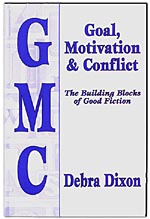
Tuesday Toolbox - Goal, Motivation, Conflict
Run, do
not walk! Run to get your hands on this book! No other book has made such a
huge impression on me as a writer as Debra Dixon’s Goal, Motivation & Conflict: The Building Blocks of GoodFiction. What I learned from this book turned my writing from
unpublishable to being seriously considered by editors and agents.
You can read
the book or Google “goal, motivation, conflict” to find in-depth analysis and
even worksheets on how to apply these concepts to your story. But here are the basics.
What
does your main character want? That’s his/her goal.
Why does
the character want these things? That’s his/her motivation.
What stands
in the character’s way of achieving what she wants? That’s the story conflict.
If you’re
writing a romance, the hero and heroine should each have their own goals and
motivations, which should bring them into direct conflict with each other.
Put it all
together and you have a compelling, believable story.
Tuesday, January 8, 2013
Tuesday Toolbox - Read!
Okay, this sounds obvious, but if you want to write books that you intend for others to read, YOU should read a lot too. I see time and again, though, that people who used to be voracious readers suddenly haven't read a book in months once they become writers. Part of the reason is simply time. You have to set your priorities. Read or write?
Well, to be good--no, great--writers, we need to read to know the market, to analyze how other authors master plot, character, pacing and many other writing techniques.
I'm as guilty as anyone else of not reading as much as I once did. I'll probably never again consistently read seven to ten full length novels a week. However, I can certainly manage a book or two a month. To hold myself accountable, I've decided to enter the Reading Romance Challenge 2013.
I won't post long, detailed reviews, and if I didn't like a book I read during the course of this challenge, I won't mention it or the author by name. As an author myself, I've made the personal decision never to publicly say anything less than complimentary about another author or their work. I am not a reviewer. I am an author, a reader, and a lover of romance novels.
To the right are the suggested categories of romance to read each month for this challenge. I'll do my best to follow it and report back each month. More importantly, I'll be reading, keeping my finger on the pulse of the market and remembering why I chose to begin writing in the first place.
I'm as guilty as anyone else of not reading as much as I once did. I'll probably never again consistently read seven to ten full length novels a week. However, I can certainly manage a book or two a month. To hold myself accountable, I've decided to enter the Reading Romance Challenge 2013.
I won't post long, detailed reviews, and if I didn't like a book I read during the course of this challenge, I won't mention it or the author by name. As an author myself, I've made the personal decision never to publicly say anything less than complimentary about another author or their work. I am not a reviewer. I am an author, a reader, and a lover of romance novels.
To the right are the suggested categories of romance to read each month for this challenge. I'll do my best to follow it and report back each month. More importantly, I'll be reading, keeping my finger on the pulse of the market and remembering why I chose to begin writing in the first place.
Tuesday, January 1, 2013
Tuesday Toolbox - Goals
I’m starting a weekly feature called Tuesday Toolbox, where I’ll post about
something essential to the writer’s “toolbox.” Since I’m starting on New Year’s
Day when everyone’s making their New Year’s resolutions, it’s only fitting that
I make today’s post about goals.
My vision for what I want is
always evolving, sometimes as soon as I commit my goals into writing. I don’t sweat
it. I simply revisit and revise my goals and, most of all, try to understand
why they’ve changed. Because of a new writing project a publisher has offered
me? Excellent. Because family life intrudes? It happens. Because I’ve been
spending all my time on Facebook? Time to reevaluate my priorities.
I am a huge fan of creating writing goals. Goals keep me on track and
focused on where I’m headed. Does that mean I meet all my goals? No. Does that
mean I can’t deviate once I’ve made a plan? No.
I have a spreadsheet where I make monthly goals. I list which books I
want/need to draft, edit, promote, brainstorm, write a synopsis, etc. Then I
have daily goals that I sometimes write in a calendar, sometimes keep in my
head. If I’m writing a draft, my goal is usually to write a minimum of 2,000
words each weekday. If my editor is expecting edits, I need to set other
projects aside to work on those.
Goals can be as elaborate or as simple as you like. You can shout them
to the world or keep them just for you. I tend to keep these things private,
but I’m also internally motivated. If you need external motivations and
deadlines to keep you accountable, share your goals with people you know will
come back and ask you if you made your goal.
Here’s another idea: My local writing group has a “goals bag,” where
each person writes a goal for the month and paperclips a dollar to it. If you don’t
make your goal, you automatically lose your dollar. If you made your goal, your
name goes in a hat with the names of all the other people who also made their
goal, and one name is pulled out who win all the dollars for that month. Band
together with a group of local writer friends, and give it a try!
Do you set goals, and do you have any tricks for keeping yourself
accountable? I’d love to hear them.
Monday, June 25, 2012
Up in my Tree House
This tree house here inspired me the most. I looked at it and immediately thought, "I want to sit in the very top room and write." As an introvert, being in the most remote space, alone with the thoughts in my head, is sheer bliss.
Unfortunately, this summer I feel like I've been stuck at the bottom of the tree pretending to be an extrovert. The constant traffic of people and activities have blocked the stairway to the quiet space in my head where I can sit alone and write. Without the quiet place of inspiration, my writing has stalled.
So I'm going to keep looking at this picture, letting that quiet upper room with the fantastic view through the trees call to me until I can push everything else aside, climb the stairs, and write.
Subscribe to:
Posts (Atom)